If implant retained dentures become a challenge for patients – a simple solution with high impact

Many patients benifit from implant retained cover dentures and gain live quality. But all day use somtimes reveals, what works well in theory can be a practical challenge.

The initial situation

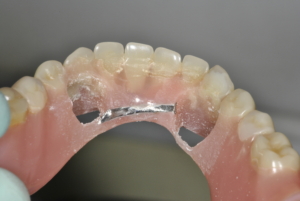
This case involves an elderly patient with severe rheumatoid arthritis in her hands (Fig. 1).

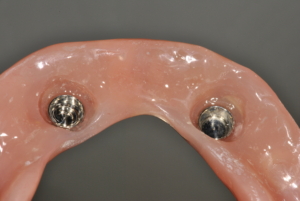
She wears a lower denture anchored to implants via locator abutments (Fig. 2). These abutments typically provide a very secure hold – which is generally desirable.

However, this very secure hold becomes a problem in this case:

  • The patient lacks sufficient hand strength.
  • Removing the denture is very difficult.
  • Even inserting it is not controlled.
  • Instead, she bites the denture into position, gradually damaging the matrices.

The consequences in everyday life

This seemingly minor problem has noticeable consequences:

  • The matrices (Fig. 3) (plastic inserts in the denture) wear out quickly.
  • They need to be replaced frequently.
  • Recurring costs arise.
  • The patient becomes increasingly frustrated.

In short: The system requires too much force for this patient to handle.

Fig. 1
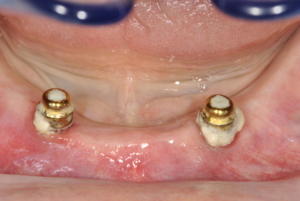
Fig. 2

Fig. 3
The Solution: Titanmagnetics

The good news: There is a simple and effective alternative.

  • Switching to a magnetic system (e.g., Titanmagnetics) offers significant advantages:
  • Significantly easier insertion and removal
  • Self-aligning positioning
  • Less force required
  • No matrix changes

This is a real game-changer, especially for patients with limited fine motor skills

The conversion is that easy

The conversion is straightforward and quick:

In the mouth:

  1. Locator-attachments are unscrewed
  2. Magnetic attachments are screwed in (Fig. 4)

In the prosthesis:

  1. Old matrices are removed
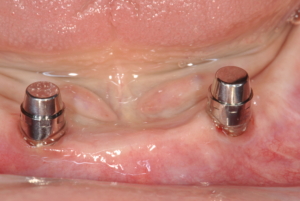
  2. The prosthesis is prepared for magnets (Fig. 5)
  3. The prosthesis magnets are incorporated (Fig. 6)

The result: A new retention system – without significant effort for the patient or practitioner. The accessories for attaching the prosthetic magnets directly to the chair protect the areas around the implant abutment from the adhesive.

The result

After the switch, an improvement is usually immediately apparent:

  • The patient can insert and remove the prosthesis independently.
  • No more biting required.
  • Significantly less wear and tear.
  • Greater security and quality of life.

Conclusion

Not every retention force is automatically good.

Especially for older patients or those with limited hand function, the prosthetic system should be tailored to the individual situation.

Magnetic attachment systems like Titanmagnetics are an excellent alternative when locator systems reach their limits in everyday life.

Fig. 4

Fig. 5

Fig. 6

Please send me catalogue and price list

© Copyright - steco-system technik GmbH & Co. KG